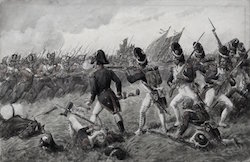
The French Revolution, the rise of Napoleon; and the worldwide conflict that ensued, retains a deep fascination to this day. Arguably the first modern global war, involving huge armies, with fighting on land and sea, it was only finally brought to an end after more than twenty years of conflict at the Battle of Waterloo in 1815. In keeping with the universal nature of the war we will travel this weekend to India, Egypt, and Italy, as well as the more familiar territory of the Iberian Peninsula, and of course Waterloo. We examine one of the Royal Navy’s most famous victories at the battle of the Nile, which dealt a fatal blow to Napoleon’s ambitions in the East. We take a look at Sir Arthur Wellesley’s first great victory at the battle of Assaye, which he later described as his finest accomplishment on the battlefield. On the 220th anniversary of the battle of Maida we investigate this largely forgotten campaign which provided a morale boost to British arms. In the Peninsula we make a detailed analysis of the close fought battle of Fuentes de Onoro, where Wellington later declared that, ‘If Boney had been there, we should have been beaten.’ The siege of Burgos was described by Wellington as his ‘worst scrape’ and we will scrutinize the reasons behind this rare failure. At Waterloo we examine the role of the Prussians, with two talks, the first of which will look at the difficulties encountered by the Prussians on the march from Wavre to Waterloo, which will be followed by an account of the desperate struggle for the village of Plancenoit.’
Speakers: Andrew W Field, John Morewood, Mark Thompson and Nigel Hope.
Arranged in co-operation with The Waterloo Association www.waterlooassociation.org.uk